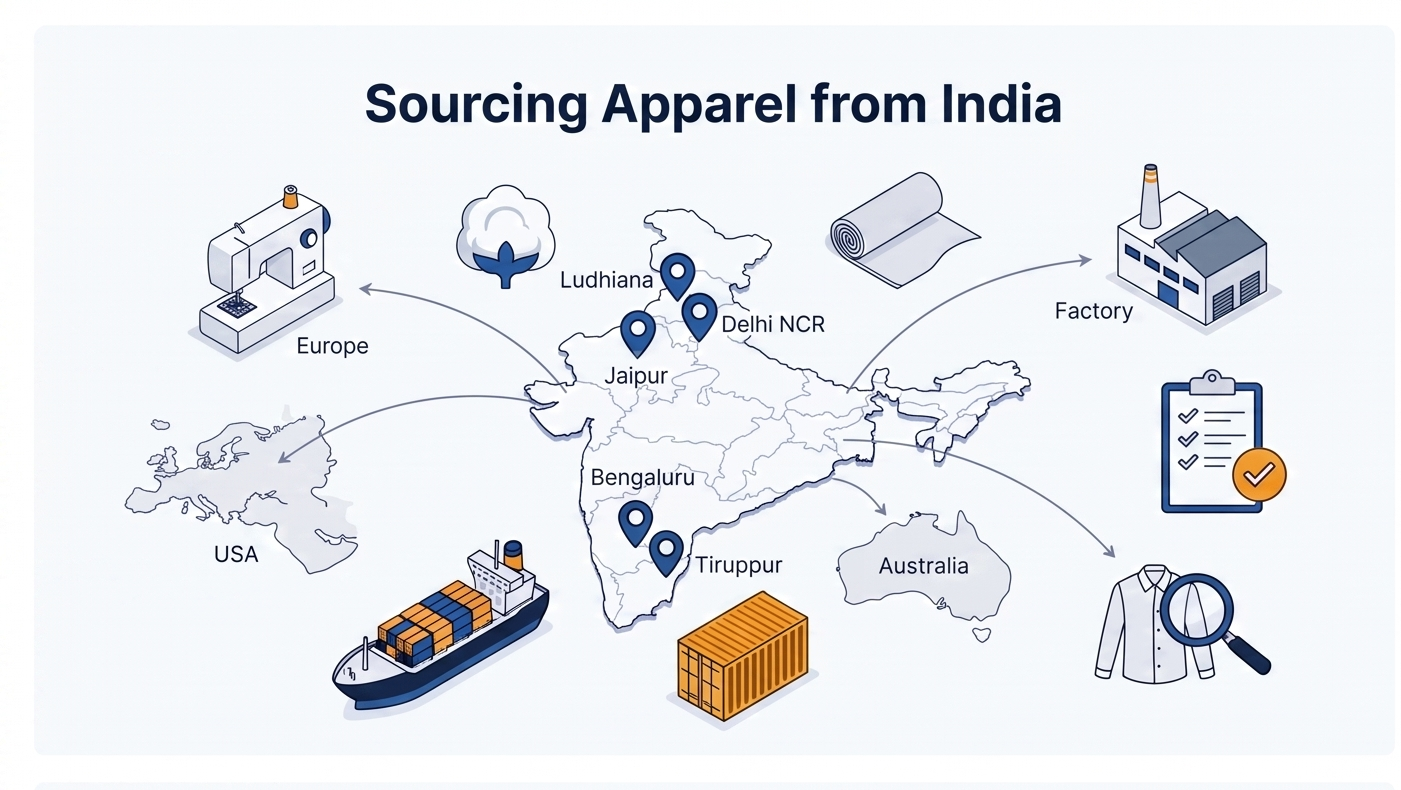
Introduction
Finding the right apparel manufacturer involves more than comparing costs on a quote sheet. The goal is a partnership with a supplier who can consistently deliver the quality your customers demand, adhere to your production calendar, and communicate with transparency. For decades, global brands, retailers, and fashion startups have turned to India as a trusted apparel sourcing destination, leveraging its deep-rooted textile history, skilled artisans, and sophisticated manufacturing ecosystem.
But successful sourcing is a discipline, not a matter of chance. The difference between a profitable partnership and a costly liability often comes down to on-the-ground diligence. Selecting an unvetted supplier or skipping crucial quality checks can trigger a cascade of issues — from production delays and inconsistent quality to rejected shipments and irreparable brand damage. This is why seasoned procurement teams build their sourcing strategy on a foundation of independent supplier verification and robust quality assurance programs.
This guide provides a practical, step-by-step framework for sourcing apparel from India. We move beyond surface-level advice to give you actionable insights from a sourcing veteran's perspective, covering everything from supplier selection and quality management to logistics and risk mitigation.
Part 1: The Strategic Advantage — Why Top Brands Source Apparel from India
India's position as a global apparel manufacturing leader is built on a unique combination of competitive strengths. The narrative has matured beyond a simple “China Plus One” alternative; today, India is a primary sourcing destination chosen for its quality, innovation, and an increasingly transparent and sustainable supply chain.
| Core Strength | Description | Strategic Benefit for Buyers |
|---|---|---|
| Vertical Integration | One of the few countries with a complete supply chain, from natural and synthetic fibers to finished garments. | Faster lead times, better control over raw materials, and reduced supply chain complexity. |
| Raw Material Abundance | As the world’s largest cotton producer, India offers reliable access to high-quality raw materials. | Stable material pricing, consistent quality, and access to a wide range of fabrics, including premium organic cotton. |
| Skilled Workforce | A long history of textile craftsmanship provides access to expertise in complex techniques like embroidery, printing, and embellishments. | Ability to produce high-value, detailed garments that command better margins. Ideal for fashion and boutique brands. |
| Design & Innovation | A growing ecosystem of design studios and technical experts helps translate trends into commercially viable products. | Collaborative product development, faster sampling, and the ability to innovate on fabrics and finishes. |
| Sustainability Focus | Home to a large number of GOTS-certified factories and a growing emphasis on organic materials and ethical production. | Meet consumer demand for sustainable apparel and achieve corporate ESG goals. |
| Market Access | Favorable trade agreements with various countries can lead to reduced duties and tariffs on imported apparel. | Improved cost-effectiveness and easier access to key consumer markets. |
India's Key Apparel Manufacturing Hubs
While manufacturing is widespread, specific regions have developed into specialized centers of excellence. Understanding these clusters helps you target your search for the right supplier.
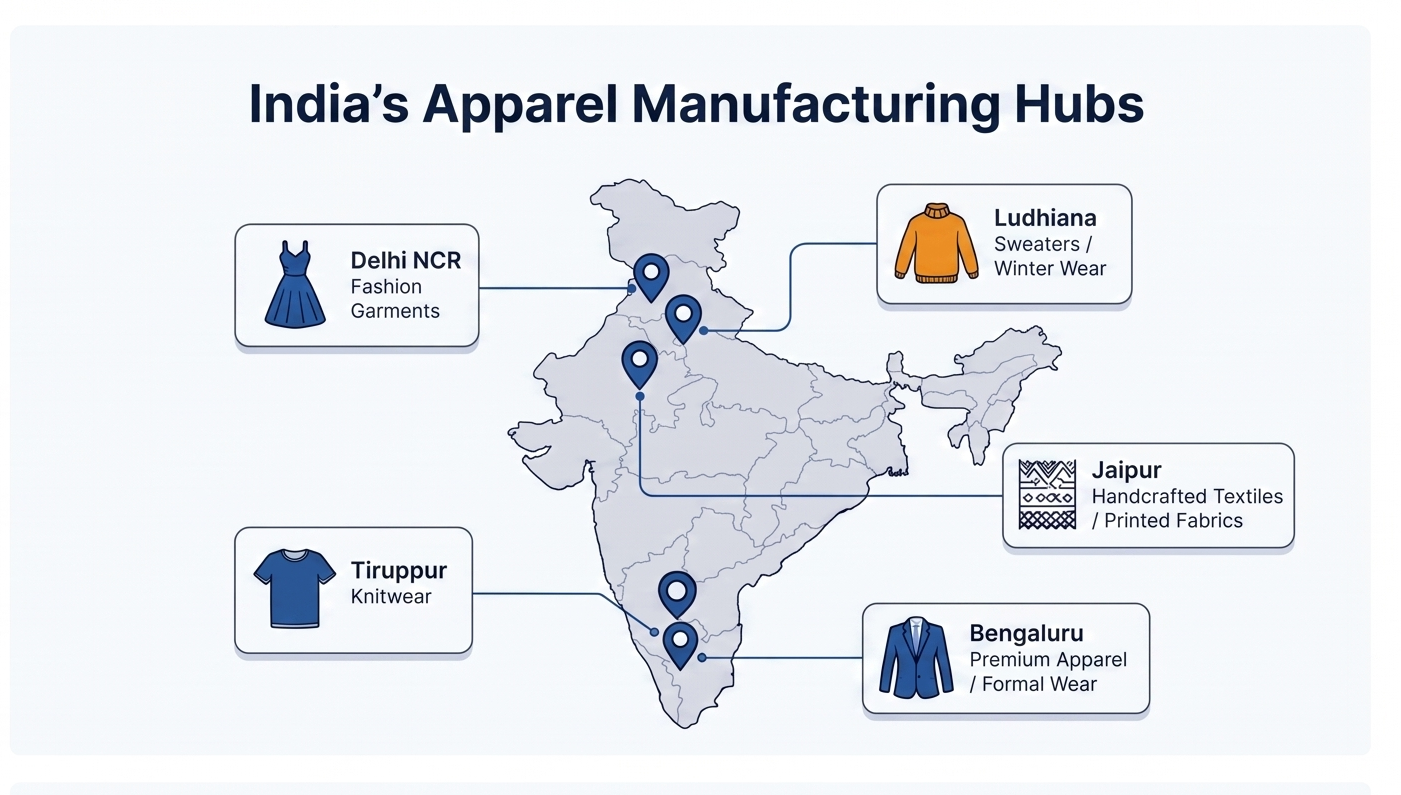
- Tiruppur (The “Knitwear Capital of India”): Located in Tamil Nadu, the undisputed hub for cotton-based knit garments — T-shirts, polo shirts, leggings, and similar products.
- Delhi NCR (Gurgaon & Noida): A center for high-fashion, value-added woven garments. Factories here produce complex dresses, blouses, and outerwear, and are well-versed in intricate embroidery and embellishments.
- Ludhiana: Known for winter wear and woolens — the go-to cluster for sweaters, sweatshirts, and cold-weather apparel.
- Bangalore: A strong hub for formal wear, denim, and high-quality woven garments, often catering to mid-to-high-end brands.
- Jaipur: Famous for traditional block printing and screen printing. A prime location for women's fashion and garments with artisanal touches.
- Mumbai: A major commercial hub with a mix of large-scale and smaller manufacturers, often focused on woven shirts and fashion apparel.
Part 2: The Sourcing Workflow — A Step-by-Step Framework
A disciplined process is the backbone of successful apparel sourcing. This 8-step framework provides a structured path from initial concept to final delivery, with built-in checks to minimize risk.
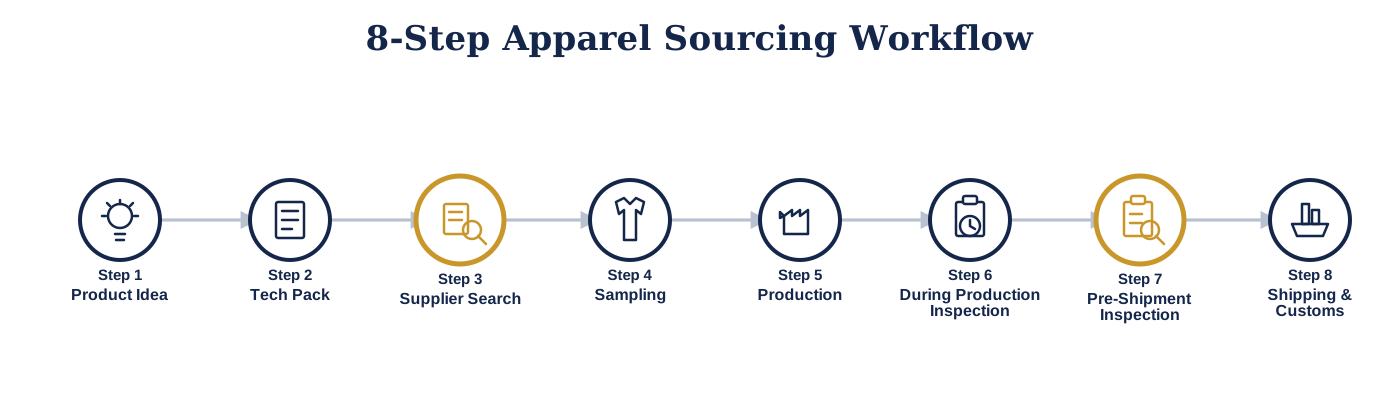
Step 1: Product Development & The Tech Pack
Before you can find a supplier, you must define your product with absolute clarity. The Technical Package (Tech Pack) is the single most important document in the entire sourcing process. It is the blueprint for your product, and a high-quality, detailed tech pack is non-negotiable.
- Technical sketches (flats) of the garment from all angles.
- A complete Bill of Materials (BOM) detailing all fabrics, trims, and accessories.
- A detailed garment specification sheet with all measurements and tolerances.
- Construction details, including stitch types and finishing instructions.
- Color standards (e.g., Pantone references).
- Artwork for any prints, embroideries, or labels.
- Packaging and folding instructions.
Step 2: Finding & Qualifying Garment Manufacturers
You can identify potential factories through online B2B directories (e.g., aepcindia.com), industry trade shows, or by partnering with a buying house. However, these methods often require extensive vetting. A lower price means nothing if the factory can't deliver — the qualification stage is about verifying a supplier's capabilities and reliability before you commit to an order.
Step 3: The Request for Quotation (RFQ) Process
Submit your tech pack to a shortlist of 3–5 qualified suppliers and request a quotation. A professional RFQ should ask for price per unit (usually in USD), the specified Incoterm (e.g., FOB, EXW), Minimum Order Quantity (MOQ), cost for samples, production lead time, and payment terms. By providing the same detailed tech pack to each factory, you ensure you receive quotes that are accurate and comparable.
Step 4: Samples, MOQs, and Lead Times
- 1
Proto Sample
The first sample made to interpret your tech pack. - 2
Fit Sample
Used to verify the garment's measurements and fit on a model or mannequin. - 3
Salesman Sample (SMS)
If needed for marketing or pre-sales. - 4
Pre-Production Sample (PPS)
The final sample approved before production begins. This sets the standard for the entire bulk order.
Minimum Order Quantities (MOQs) are the minimum number of units a factory will produce per style or color — often determined by the fabric supplier's minimums. While sometimes negotiable, be prepared to meet these requirements.
| Garment Type | Estimated Production Lead Time |
|---|---|
| Basic Knit T-Shirts | 45–60 days |
| Fashion Woven Dresses | 75–90 days |
| Complex Outerwear | 90–120 days |
Step 5: Purchase Orders and Production Kick-off
Once you approve the pre-production sample and finalize costs, issue a formal Purchase Order (PO). The PO is a legally binding contract that should include all final details: quantities, prices, delivery dates, quality standards, and payment terms. Upon receipt of the down payment, the factory will begin sourcing materials and start production.
Step 6: Production & Quality Management
This is where proactive quality management becomes critical. Relying solely on the factory's internal QC is a significant risk. This is the stage where you deploy your quality assurance strategy, covered in-depth in Part 3 below.
Step 7: Logistics Planning & Incoterms
As production nears completion, begin planning your logistics. This involves booking a freight forwarder who will manage the shipment from India to your final destination.
- FOB (Free On Board): The supplier is responsible for all costs and risks until the goods are loaded onto the shipping vessel. This is the most common Incoterm for apparel sourcing.
- EXW (Ex Works): You (the buyer) are responsible for everything, including picking up the goods from the factory. More control, but more responsibility.
- CIF (Cost, Insurance, and Freight): The supplier is responsible for cost, insurance, and freight to the destination port. Less common as it gives the buyer less control.
Step 8: Payments & Customs
The final payment is typically made after the goods have passed a final inspection and are ready for shipment. Common terms include Letter of Credit (L/C) for large, high-value orders, and Telegraphic Transfer (T/T) — commonly structured as a 30% down payment to start production and the remaining 70% upon completion and inspection. Your freight forwarder will manage customs clearance in both India and your home country.
Part 3: Proactive Quality Management — Your On-the-Ground Defense
The single biggest financial risk in sourcing is paying for defective products. A proactive Quality Assurance (QA) program shifts quality verification from a reactive, post-delivery problem to a proactive, in-factory solution. The goal is to identify and fix issues before they become irreversible and before you make the final payment.
1. Supplier Qualification Audits
- Factory Audit — Your initial due diligence. Verifies the factory is a legitimate operation, assesses production capacity, and evaluates its Quality Management System.
- Technical Audit — For complex or high-stakes products. Evaluates machinery, maintenance programs, and the technical skill of staff.
- Social & ESG Compliance Audits — Assesses the factory against international standards for health, safety, working hours, and fair wages. Often follows guidelines from the OECD .
Uncertain about a new supplier?
A Factory Audit is your first step to secure sourcing.
Request an On-Site Audit2. In-Process Inspections
During Production (DUPRO) Inspection — An inspector visits the factory when 15–20% of the order is complete. They check the quality of the first finished units against your approved sample and tech pack. This is the most effective way to identify and correct misunderstandings, workmanship issues, or material defects before they are replicated across thousands of garments.
3. Final Pre-Shipment Inspection (PSI)
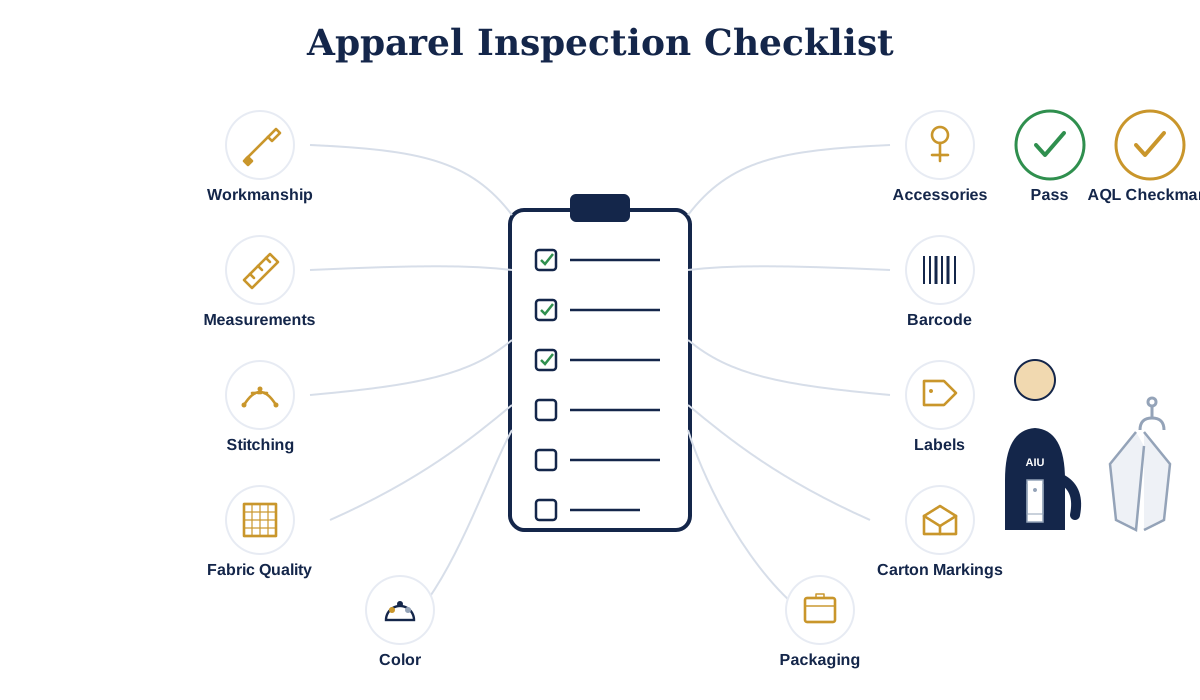
The Pre-Shipment Inspection (PSI) takes place once 100% of the order is produced and at least 80% is packed. It is your final opportunity to verify the quality of the goods before they leave the factory and before you make your final payment.
An independent inspector performs a random sampling of the finished goods based on the internationally recognized AQL (Acceptable Quality Limit) standard (typically based on ISO 2859-1 ). The inspection covers workmanship and visual defects, garment measurements and fit, material and color verification, on-site function and safety tests (e.g., pull tests on buttons), and packaging, labeling, and carton markings.
4. Container Loading Supervision (CLS)
Container Loading Supervision (CLS) verifies that the correct, approved goods are loaded into the shipping container. It ensures that the quantity loaded matches your order, the cartons are handled correctly, and the container is properly sealed for transit. This simple check prevents shortages, damage during transit, and disputes upon arrival.
Your order is produced and approved
Ensure it ships correctly and securely.
Book Container Loading SupervisionPart 4: Building Sustainable Partnerships & Mitigating Risks
Common Sourcing Mistakes and How to Avoid Them
| Mistake | Consequence | Mitigation Strategy |
|---|---|---|
| Selecting a supplier on price alone | Poor quality, production delays, communication breakdown, brand damage. | Conduct thorough supplier qualification, including a Factory Audit, before committing. |
| Providing an incomplete Tech Pack | Incorrect samples, inaccurate pricing, production errors, disputes over quality. | Invest in creating a detailed, comprehensive tech pack with all specifications. |
| Skipping in-process inspections | Defects are replicated across the entire production run, leading to costly rework or rejected shipments. | Implement a During Production Inspection for all significant orders. |
| Relying only on the factory's QC | The factory’s incentive is to ship, not to find problems. Issues are often overlooked or hidden. | Always use an independent Third-Party Inspection service for final quality verification. |
| Vague Communication | Misunderstandings about specifications, deadlines, or quality expectations. | Use clear, written communication. Reference the tech pack and approved samples in all correspondence. |
| Unauthorized Subcontracting | Loss of quality control, non-compliance with ethical standards, and potential production delays. | Your supplier agreement should prohibit unauthorized subcontracting. Verify with on-site inspections. |
Decoding Hidden Sourcing Costs
The price on the PO is rarely the final landed cost. Be aware of these potential additional expenses:
- Sample development and shipping fees.
- Cost of third-party inspections and audits.
- Freight forwarding and shipping charges.
- Marine insurance.
- Import duties, taxes, and tariffs in your home country.
- Customs brokerage fees.
- Domestic transportation from the port to your warehouse.
- Currency exchange rate fluctuations.
Supplier Relationship Management
Think of your best suppliers as partners, not just vendors. Building a strong relationship involves clear communication, fair negotiations, consistent order flow, on-time payments, and collaborative problem-solving when issues arise.
A strong partnership, supported by a consistent and fair quality management program, is the most effective way to build a resilient and reliable apparel supply chain.
Part 5: Your Partner on the Ground in India
Sourcing from thousands of miles away presents inherent challenges. You need a trusted partner on the ground who can act as your eyes and ears, providing unbiased, data-driven insights to help you make critical decisions. This is the role of an independent third-party inspection company.
AIU Inspections provides on-site verification that international buyers need to navigate the complexities of sourcing from India. Our services are designed to integrate into your sourcing workflow, delivering confidence at every stage:
- Before Production: Vet and select the right partners with our Supplier Evaluation and Factory Audits.
- During Production: Real-time visibility into your manufacturing process with During Production Inspections, allowing for early course correction.
- Before Shipment: Final verification with Pre-Shipment Inspections, ensuring quality standards are met before you release payment.
- At Shipment: Verified loading with Container Loading Supervision.
Ready to source from India with confidence?
Our team provides the on-the-ground intelligence you need to protect your brand, prevent quality issues, and build a resilient supply chain.
Key Takeaways
- India offers a strategic advantage for apparel sourcing due to its vertical integration, skilled workforce, and focus on quality and sustainability.
- A detailed Tech Pack is the single most critical document for preventing errors and ensuring accurate pricing.
- Never select a supplier based on price alone. Always conduct thorough qualification, including a formal factory audit for new partners.
- A proactive Quality Assurance program, including in-process and pre-shipment inspections, is essential for mitigating risk.
- The AQL standard is the industry benchmark for conducting objective, random inspections to verify shipment quality.
- Building long-term, collaborative relationships with reliable suppliers is more profitable than constantly chasing the lowest price.